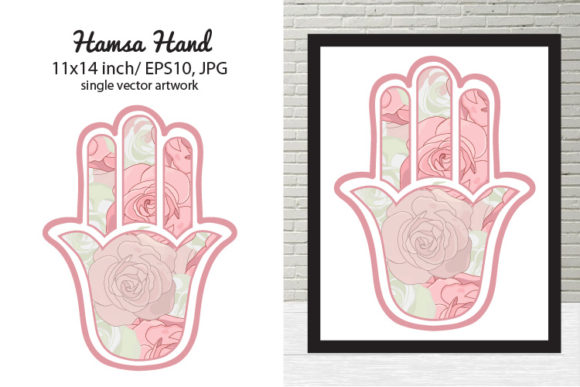
Hamsa Hand Vector Artwork: Selecting the Right 11x14 Format for Professional Results
The Hamsa Hand is one of the most enduring symbols in visual culture, representing protection, blessings, and strength across numerous traditions. For designers, educators, and business owners, incorporating this symbol into projects requires more than just finding an attractive image; it demands technical precision and cultural respect. When sourcing a Floral Hamsa Hand vector artwork specifically formatted for an 11x14 inch artboard at 300 DPI, you are likely preparing for high-quality print materials, wall art, or detailed digital presentations. However, many creators encounter avoidable issues during the selection and implementation process that compromise the final output.
Understanding the specific technical parameters of this asset is the first step toward avoiding disappointment. A ZIP file containing both an EPS Version 10 file and a 300 DPI JPG offers versatility, but only if you understand how to leverage each format correctly. Misunderstanding these specifications often leads to pixelated prints, uneditable files, or color mismatches that require expensive reprints or time-consuming redesigns. By addressing common pitfalls early, you ensure your project honors the symbol’s significance while meeting professional production standards.
Navigating File Formats and Compatibility Issues
One of the most frequent mistakes occurs when users assume all vector files behave identically across software platforms. The inclusion of an EPS Version 10 file is a deliberate choice for maximum compatibility, yet many beginners overlook its importance in favor of newer formats they cannot open or edit properly. EPS Version 10 is the industry standard for cross-platform reliability. If you attempt to open a newer AI or EPS file in older versions of Illustrator, CorelDRAW, or free alternatives like Inkscape, you may face broken gradients, missing fonts, or expanded strokes that ruin editability.
Conversely, relying solely on the included JPG file for print production is a critical error. While the JPG is provided at 300 DPI for the 11x14 inch size, it remains a raster image. This means it has a fixed resolution ceiling. If your client requests a banner or billboard later, that same JPG will become unusable. Always treat the JPG as a proofing tool, a mockup element, or a fallback for non-vector environments. Your primary working file should always be the EPS. Before purchasing or downloading, verify that your design software supports EPS import without rasterization. Testing with a sample file can save hours of frustration later.
Color Space Confusion: RGB vs. CMYK for Print
This specific artwork package is delivered in an RGB color palette. This detail is frequently overlooked by those accustomed to traditional offset printing workflows. RGB offers a wider gamut of vibrant colors, making it ideal for digital displays, web graphics, and modern digital printers. However, sending an RGB file directly to a commercial offset press without conversion can result in dull, muddy colors because the printer cannot reproduce the full RGB spectrum.
To avoid this, assess your end-use before applying the artwork. For digital products, social media content, or home inkjet printing, the native RGB palette is perfect. For professional lithography or screen printing, you must convert the file to CMYK within your vector editor. Because this is a vector file, conversion is non-destructive and adjustable. Do not rely on automatic online converters for this task, as they often apply generic color profiles that shift hues unpredictably. Instead, use your design software’s color management tools to preview the RGB-to-CMYK shift and adjust specific floral tones manually to maintain vibrancy. Ignoring this distinction is the primary cause of "why does my print look different than my screen?" complaints.
Respecting Cultural Context in Design Application
Beyond technical specifications, using the Hamsa Hand carries a responsibility to avoid aesthetic or cultural missteps. A common oversight is treating the symbol as mere decoration without understanding its orientation and styling conventions. Traditionally, the Hamsa can face upward (receiving blessings) or downward (warding off evil). Arbitrarily rotating or mirroring the vector artwork to fit a layout without considering this meaning can inadvertently alter the symbol’s intent, which may alienate audiences familiar with its heritage.
Additionally, the integration of floral elements requires balance. Over-modifying the vector paths to add excessive textures or conflicting stylistic elements can clutter the design and diminish its clarity. The 11x14 inch artboard size provides ample negative space; resist the urge to fill every corner. Clean, scalable lines are the hallmark of quality vector art. If you modify the artwork, maintain consistent stroke weights and anchor point hygiene. Messy vectors with unnecessary nodes not only increase file size but also create jagged edges when scaled, defeating the purpose of using vector format in the first place.
Evaluating Resolution and Scaling Limits
While vectors are theoretically infinitely scalable, the accompanying 300 DPI JPG serves as a crucial reference point for intended usage. At 11x14 inches, 300 DPI equals exactly 3300 x 4200 pixels. This is the benchmark for sharp, professional-grade printing at that specific size. A practical mistake is assuming the JPG can be upscaled beyond these dimensions without quality loss. Even though you have the EPS, the JPG preview helps you visualize the intended level of detail.
If your project requires a size significantly larger than 11x14 inches, work exclusively from the EPS and ignore the JPG entirely. Conversely, if you are designing for small-scale applications like business cards or app icons, do not simply shrink the 11x14 artwork. Complex floral details that read beautifully at poster size may disappear or create moiré patterns at thumbnail scale. Simplify the vector artwork by removing intricate inner details for smaller applications. This adaptive approach ensures legibility and impact regardless of the final output size, rather than forcing a single composition to serve incompatible purposes.
Pre-Purchase Verification Checklist
Making informed decisions before acquiring digital assets prevents wasted budget and creative dead ends. Before committing to this Hamsa Hand vector package, run through these practical verification steps:
- Software Compatibility: Confirm your current design application opens EPS Version 10 files cleanly. Test with a free sample if uncertain.
- Color Workflow Alignment: Determine whether your output destination requires RGB or CMYK, and plan your conversion strategy accordingly.
- Licensing Clarity: Verify the license permits your specific use case, especially for commercial merchandise, logos, or trademarked applications where restrictions commonly apply.
- Detail Assessment: Zoom into the JPG preview at 100% to evaluate line quality and complexity. Ensure the artistic style matches your brand’s existing visual language.
- Artboard Flexibility: Consider whether the fixed 11x14 inch artboard suits your needs, or if you will need to expand/crop the canvas immediately upon opening.
Taking these preventative measures transforms a simple file download into a reliable design foundation. The combination of a versatile EPS and a high-resolution reference JPG provides everything needed for professional execution, provided you approach the asset with technical awareness and cultural mindfulness. Quality results stem not just from the artwork itself, but from the thoughtful application of correct workflows and respectful design practices.