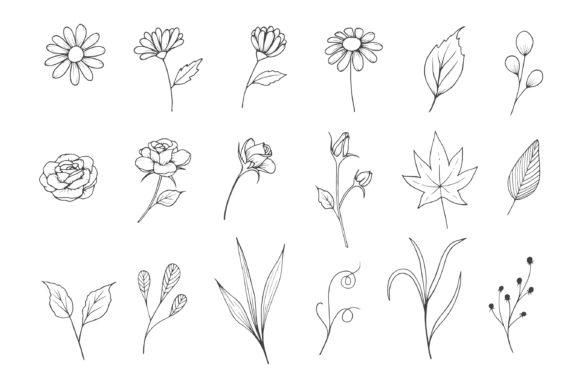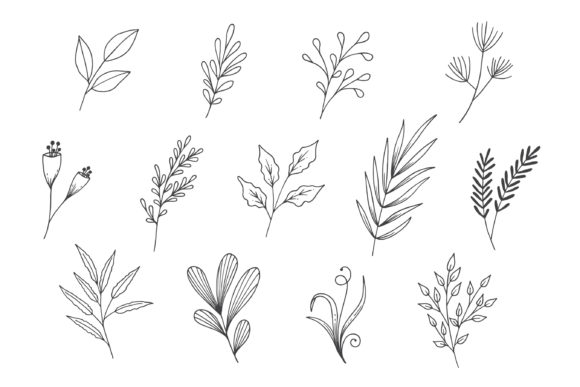
Natural Leaves Line Art Collection for Design
Elevating visual communication often requires finding the balance between organic warmth and professional clarity. The Natural Leaves Line Art Collection addresses this specific design challenge by providing hand-drawn botanical illustrations that maintain a clean, minimalist aesthetic. Unlike complex, full-color floral patterns that can compete with text or overwhelm a layout, these black and white decorative floral sketches on white backgrounds serve as versatile structural elements. They offer the texture of nature without the visual noise, making them particularly valuable for professionals who need to convey sophistication and tranquility in their projects.
This collection is not merely a set of clip art; it is a curated library of line-style assets designed for scalability and adaptation. Whether you are a freelance graphic designer working on branding packages, an educator creating engaging worksheets, or a small business owner managing your own marketing materials, having access to high-quality vector line art solves common production bottlenecks. The inclusion of 13 individual SVG files alongside raster formats ensures that every leaf maintains crisp edges whether printed on a business card or displayed on a large-format banner.
Streamlining Brand Identity with Vector Scalability
One of the primary advantages of this collection lies in the technical flexibility provided by the file formats. For brand designers and marketers, consistency across touchpoints is non-negotiable. The 13 SVG files included in this package allow for infinite scaling without loss of quality. This is essential when developing responsive web designs where assets must adapt to various screen sizes, or when preparing print materials that range from packaging labels to storefront signage.
Because these are true vector files, they also support color manipulation directly within design software. While the default presentation is black and white, a designer can easily adjust the stroke color to match a specific brand palette using Adobe Illustrator (AI) or EPS files. This capability transforms a generic botanical sketch into a proprietary brand asset. For example, a sustainable skincare line might shift the line color to a muted sage green to reinforce their eco-friendly positioning, while a luxury wedding stationer might opt for a metallic gold stroke. The hand-drawn nature of the lines prevents the design from looking sterile or digitally generated, preserving an artisanal quality that resonates with consumers seeking authenticity.
Enhancing Editorial and Educational Layouts
For publishers, bloggers, and educators, the challenge often involves breaking up dense blocks of text without introducing distracting imagery. The Natural Leaves Line Art Collection functions effectively as negative space management. The open line style allows background colors or textures to show through the illustration, integrating the graphic seamlessly into the page layout rather than sitting on top of it as a heavy, opaque block.
In educational contexts, such as workbook creation or curriculum design, these sketches provide visual anchors that aid retention without overstimulating learners. A biology teacher illustrating plant anatomy or a language arts instructor designing poetry journals can use these neutral sketches to add thematic relevance. The PSD file inclusion is particularly useful here, as it allows users to isolate specific elements, adjust opacity, or layer the leaves behind text boxes in Photoshop. This practical utility extends to digital content creators who need consistent visual motifs for social media templates, blog headers, or newsletter dividers. Having a cohesive set of 13 distinct variations means you can create a unified visual language across an entire campaign or publication series without sourcing mismatched assets from different artists.
Technical Versatility Across Software Platforms
Creative workflows vary significantly between professionals and hobbyists. Some users operate exclusively within the Adobe Creative Cloud ecosystem, while others rely on Canva, Procreate, or Cricut Design Space. This collection acknowledges that diversity by providing a comprehensive suite of file types. Beyond the standard AI and EPS vectors for professional editing, the inclusion of high-resolution PNG and JPEG files ensures immediate usability for those without vector editing software.
The single PNG containing all files serves as a quick-reference catalog or a composite asset for mood boarding. Meanwhile, individual PNGs with transparent backgrounds are ready for drag-and-drop application in user-friendly design tools. This reduces the friction between acquiring an asset and implementing it. For crafters and makers using cutting machines, the SVG files provide clean paths that minimize node count, resulting in smoother cuts and less material waste. Understanding which file to use for which task is crucial:
- SVG/EPS/AI: Best for logo design, large format printing, color customization, and cutting machines.
- PSD: Ideal for photo compositing, digital painting overlays, and complex layer-based editing.
- PNG: Perfect for web graphics, presentations, Canva templates, and documents requiring transparency.
- JPEG: Suitable for quick previews, low-resolution drafts, and platforms that do not support transparency.
Evaluating Fit and Stylistic Limitations
While the Natural Leaves Line Art Collection offers significant utility, it is important to assess whether this specific aesthetic aligns with your project goals. The hand-drawn line style implies a certain level of informality and organic imperfection. If your project requires photorealistic botanical accuracy or highly geometric, futuristic precision, this collection may not be the appropriate fit. The charm of these illustrations lies in their sketch-like quality, which communicates warmth and approachability rather than scientific exactitude or corporate rigidity.
Additionally, users should consider the contrast requirements of their intended medium. Because these are black and white sketches on white backgrounds, they rely heavily on line weight for visibility. When placing these assets on dark backgrounds, simply inverting the color may not always yield the best result if the original lines were optimized for light surfaces. Professionals should test the assets at actual size in the final output environment before committing to large-scale production. For those needing multicolor gradients or filled shapes, additional editing time will be required to convert the line art into closed paths suitable for filling.
Maximizing Efficiency in Creative Production
Time is often the most constrained resource for freelancers and small business owners. Sourcing individual botanical elements from disparate sources leads to stylistic inconsistency and licensing headaches. By utilizing a cohesive collection like this, creators eliminate the hours spent searching for matching assets. The 13 unique leaf variations provide enough diversity to prevent repetition fatigue while maintaining a singular artistic voice.
This efficiency extends to client revisions. When a client requests a "more natural feel" or "softer accents," having a pre-vetted library of hand-drawn line art allows for rapid iteration. Instead of drawing new elements from scratch or purchasing multiple single-use licenses, you can cycle through the collection to find the right composition. For entrepreneurs managing seasonal promotions, these timeless botanical sketches transcend specific holidays, offering year-round utility. They work equally well for spring garden sales, autumn harvest events, or winter wellness campaigns, simply by adjusting the accompanying typography and color context.
Ultimately, the value of the Natural Leaves Line Art Collection is found in its role as a foundational design tool. It bridges the gap between custom illustration and stock convenience, providing high-quality, editable assets that respect both the creator's time and the audience's aesthetic experience. By understanding the technical specifications and appropriate use cases for each file type, users can integrate these hand-drawn elements to enhance clarity, strengthen brand identity, and bring a touch of organic elegance to their digital and print communications.